
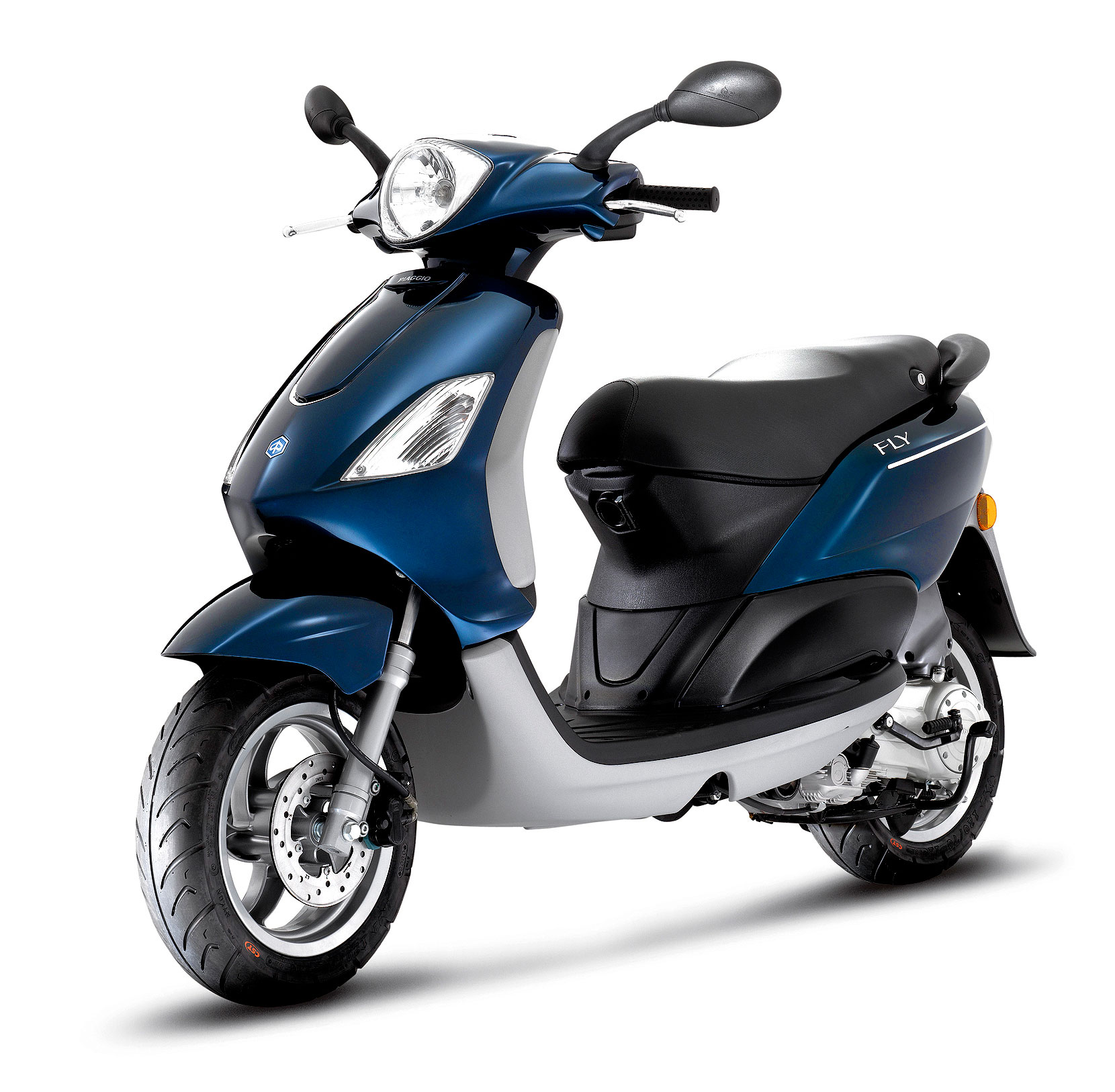
PIAGGIO FLY 50 / 150
The Fly is Piaggio’s offering to mainstream scooter buyers. You won’t find the high end chrome, metal body construction and price tag of Vespa here, nor will you find the aggressive styling of a sports scooter. Rather, the Fly is an excellent blend of all the characteristics that make scooters a practical choice, and thus it has been popular with mainstream buyers.
The Fly uses the same motors found in small frame Vespa’s, but often without the latest technology to keep the price lower. This motor is housed within a fairly typical modern scooter design consisting of a metal frame with plastic panels. Globally, the Fly is Piaggio’s most popular model because it fully embodies the practical scooter ethos of affordability, convenience and riding enjoyment.
Models
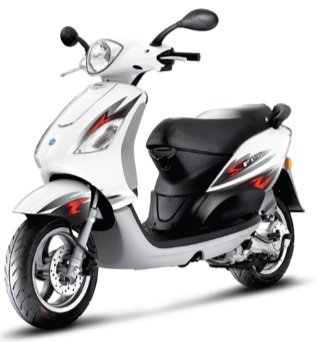
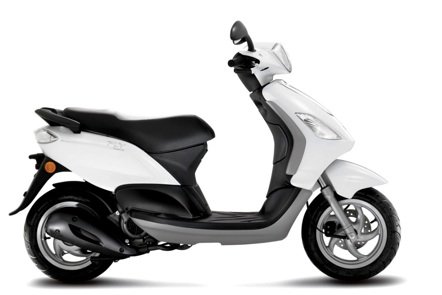
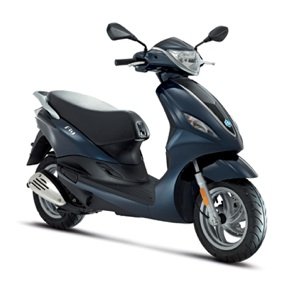
The first generation Fly (shown below) was first introduced to North America as a 150cc model. It debuted in the USA for 2005 and in Canada the following year. The smaller 50cc version followed for the 2007 model year in both markets – first utilizing a 2-stroke 50cc motor before switching to a 4-stroke engine for 2008.
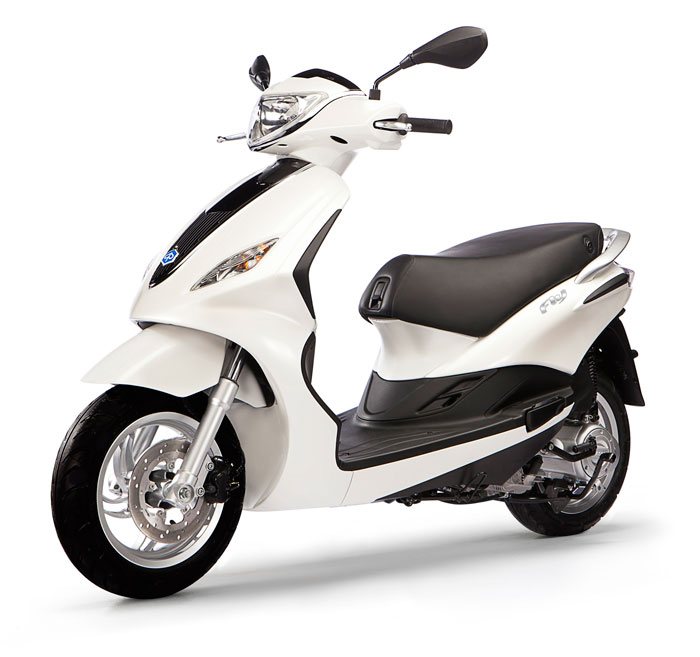
 Globally, the Fly received a major redesign circa 2013, with this second generation Fly (shown at top) arriving in the USA as an early release 2014 model as the Fly 50 and Fly 150. This updated design was first shown at the Milan motorcycle show in fall 2011 and entered production in fall 2012 but didn’t arrive in North America until a year later. This angular new Fly is almost entirely new. The more angular look is a nice restyling for the Fly. The new lines are crisp and modern and should look good for quite some time. The styling is also less generic than the first generation, which helps this model stand out from some of the cheaper scooters on the market.
The second generation Fly also arrived in Canada for 2014 in both 50cc and 150cc forms, but only the 50cc version was sold after 2014.
Motors
The Fly scooters share their motors with Vespa’s scooters of the same displacements, while often lagging their more expensive Vespa counterparts by a year or two in getting the latest technology. The 2-stroke Fly 50 (sold only in 2007) used Piaggio’s Hi-PER2 motor which was also found in Vespa’s ET2 50. For 2008, the Fly 50 starting using the Piaggio group’s 4-stroke Hi-PER4 motor that is also found in the Vespa LX 50 and S 50.
For 2011, the Fly 50 received a 4-valve version of the Hi-PER4 motor (as opposed to the earlier 2-valve design) which offers a moderate boost in fuel milage and power over the 2-valve variant it replaces. This 4-valve variant had been offered since 2009 in Vespa’s LX 50 and S 50 models. Both the 2-valve and 4-stroke Hi-PER4 motors can saunter to a top speed of 40 mph, but the 4-valve version sips a little less fuel in doing so. Piaggio does claim a small power increase for the 4-valve motor (4.3HP vs. 4.1HP), which are both still far behind the 5.1HP the less fuel efficient 2-stroke motor was capable of.
The Fly 150 utilizes the same ‘LEADER’ motor as Vespa’s 150cc LX and S scooters and the ET series before that. The first generation Fly 150 did not use fuel injection, so pre-2014 models achieve 11.6 HP with good reliability and average fuel economy. This translate to a top speed of 60-62mph. The second generation (2014) Fly 150 receives an overhauled LEADER motor with fuel injection and 3 valves. This improves fuel mileage to an excellent 75 mpg. Power is up half a pony as well to 12.1 HP @ 7000 RPM.

 Brakes / Suspension / Handling
Unlike their Vespa relatives, the Fly 50 and 150 use larger 12” wheels which provide better stability at higher speeds. It’s not an issue with the 50cc models, but the 150cc Vespa’s can be twitchy at top speed due to their smaller wheels and high-ride height.
The job of stopping the first generation of Fly was handled by a dual piston 200mm disc brake in the front and a 140mm drum brake in the rear. Despite nice specs, the front brake was only mediocre. The feel was a bit wooden and it required higher than average lever pull effort. Good stopping power is possible, but it requires a firmer squeeze than most scooters.
With the 2014 redesign, Piaggio increased the front brake to 220mm (from 200mm) and lowered the seat height from 30.9” to 29.9”, which is a welcome change. Front brake performance is now quite strong and ride stability is improved.
Design and Amenities
In practical terms, the Fly scooters score well. The underseat storage area is generous, with the caveat that this area does get fairly hot due to its engine proximity. It’s certainly not a good spot for storing the ice cream. It’s also not a good place for pets, as Piaggio’s comically abundant warning stickers will tell you. The Fly 50 and 150 do have a nice glovebox which comes in handy and sets this scooter apart from quite a few competitors that offer either an open storage slot or nothing at all.
Discussion
 The Fly scooters are sharp designs so their popularity is easy to understand. They aren’t class leading in terms of price, technology or refinement, but they are a well rounded package. They are built well and supported by a large network of dealers and a solid owner community.
The Fly 50 and 150 should appeal to someone seeking a scooter with a modern look who’s looking for good value, as opposed to just the lowest purchase price. The Fly scooters are well featured with enclosed storage areas, quality and powerful motors and front disc brakes. The inclusion of a proper glove box is small but valued detail that separates the Fly from quite a few competitors.
Piaggio is asking $2299 for the Fly 50 which is a very fair price. You can buy cheaper (and less featured) scooters like Kymco’s super low priced Agility 50 ($1399), but most scooters of this caliber sell for a similar price. The Fly 150 goes for $2999 which is a lot more affordable than its high end motor sharing counterpart, the $4599 Vespa Primavera 150. The most direct competitors to the Fly are from the Japanese makers (Honda, Yamaha) which also offer a compelling well rounded scooters. In particular, Honda’s PCX150 is a strong competitor to the Fly 150. It is more expensive at $3449, but it also a more refined and technologically advanced machine and thus offers a little better power and fuel mileage.
Pros:
- Stability at speed due to 12” wheels
- Reliable and powerful motors
- Enclosed glovebox storage
- Affordable
Cons:
- Below average fuel economy in first generation
- Generic styling (first generation)
Links:
MotorscooterGuide Forums – Visit the forums on this site to chat about this scoot.
Piaggio Fly 150 Review – Nice bit of journalism on the larger Fly by Motorcycle-USA
Piaggio Fly 150 3V Review – Thoughts on the Fly from JustGottaScoot
ModernVespa – These forums are a good spot to find other owners
Key Specs – Fly 50:
- Engine: Air cooled, 2-stroke 49cc OR 4-stroke, 4-valve 49cc
- Power: 5.1hp (2-stroke 49cc), 4.1 hp (pre-2011 4-stroke 49cc), 4.3hp (4-valve, 4-stroke, 50)
- Transmission: CVT
- Bore & Stroke: 40mm x 39.3 (2-stroke 49cc), 39mm x 41.8mm (4-stroke 49.4cc)
- Compression Ratio: 10.3:1 (49cc)
- Fuel Delivery: Carbureted
- Wheelbase: 52.4” / 52.2”
- Weight: 220 lbs (49cc)
- Starter: Electric and Kick (only on pre-2014 models)
- Seat height: 30.9” (pre-2012), 29.9” (2014 model)
- Fuel Tank: 1.9 gallon / 1.7 gallon (2014 model)
- Front Brake: 200mm dual piston disc brake / 220mm (2014)
- Rear Brake: 140mm drum
- Front Suspension: Telescoping forks, 2.3” travel
- Rear Suspension: Single shock, 3.0” travel
- Tires: 120/70-12 (Front and Rear)
- MSRP: $2099 (2011 USA), $2299 (2014 USA)
Key Specs – Fly 150:
- Engine: 2-valve 150cc single cylinder (2005 – 2013) or 3-valve 150cc single cylinder (2014-present)
- Power: 11.6 hp (’05 – ’13), 12.1 hp @ 7000 RPM and 9.5 lbs-ft torque @ 6000 RPM (2014)
- Transmission: CVT
- Bore & Stroke: 62.6mm x 48.6mm (’05 – ’13), 57.9mm x 58.4mm (2014)
- Compression Ratio: 10.3:1 (49cc), 10.1:1 (150cc)
- Fuel Delivery: Carbureted (’05 – ’13), Fuel Injected (’14)
- Wheelbase: 52.4” / 52.2”
- Weight: 247 lbs (150cc)
- Starter: Electric and Kick (only on pre-2014 models)
- Seat height: 30.9” (pre-2014), 29.9” (2014 model)
- Fuel Tank: 1.9 gallon / 1.8 gallon (2014)
- Front Brake: 200mm dual piston disc brake (Gen 1), 220mm dual piston floating caliper (2014)
- Rear Brake: 140mm drum
- Front Suspension: Telescoping forks, 2.3” travel)
- Rear Suspension: Single shock, 3.0” travel, adjustable preload
- Tires: 120/70-12 (Front and Rear)
- MSRP: $2899 (2011 – 2014 USA)
Colors:
- 2005 – 2013: Midnight Blue, Optic White, Excalibur Gray
- 2014 – 2016: Pearl White, Graphite Black
- 2017 – 2018: Pearl White, Graphite Black, Midnight Blue (150 only)
- 2017 – 2018: Pearl White, Graphite Black, Blue