
Yamaha Scooters – Every Model, Every Year
 This page contains a year by year description of the Yamaha’s scooter lineup. For detailed information on a specific Yamaha scooter use the menu to the right.
While Yamaha’s history with scooters includes the 1960 SC-1 (175cc 2-stroke available only in Japan), the V-series (think pedal-less mopeds) and the 1977 Passol (Japan only scooter), this section deals with only the Yamaha scooters which made it to North America.

 1982
1982
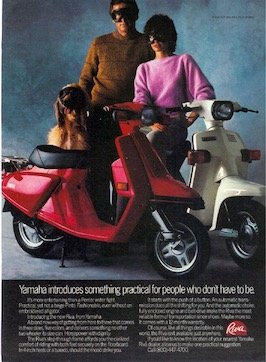
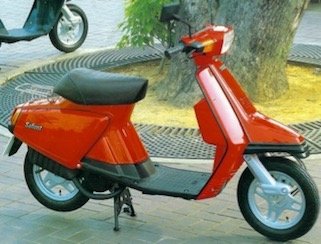
The 50cc Salient (CA50) and 80cc Beluga (CV80, above in white) became the first modern scooters to be sold in North American when they hit the market in Canada for 1982, one year before Honda arrived in North America with their Aero 50 and Aero 80 scooters. These scooters were designed to be the next generation of scooter with their dent resistant plastic body panels, CVT transmissions and oil injection. These features made these scooters easy to operate for a wider appeal.
MODELS: Salient (Canada only), Beluga (Canada only)
1983
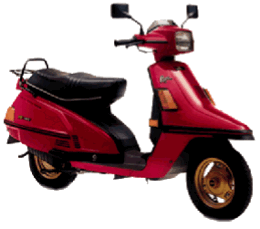 A year after going on sale in Canada, Yamaha released the CA50 and CV80 scooters in the USA market as the Riva 50 and Riva 80 respectively.
Yamaha also introduced the larger Riva 180 (XC180) scooter in both markets for ’83. This scooter was capable of impressive top speeds around 75mph. The Riva 180 is a good scooter but it is infamous for starting difficulties. Yamaha designed overly complex auto choke systems for many of their Riva scooters, which often don’t work if you are pulling one out of a garage after sitting for a decade.
MODELS: Salient / Riva 50, Beluga / Riva 80, Riva 180
1984
Canadians got an updated version of the CV80 Beluga scooter with a host of improvements resulting in a significantly higher top speed (45mph instead of 38mph). These improvements include a larger carburetor, new cylinder and redesigned exhaust. Americans would have to wait another year for these upgrades. These upgrades may have been a response to Honda’s Aero 80 scooter, which was significantly peppier.
MODELS: Salient / Riva 50, Beluga / Riva 80, Riva 180

 1985
1985
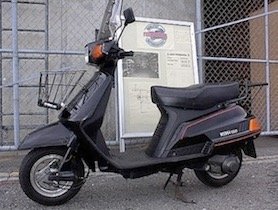
For 1985, Yamaha released the improved CV80 scooter to the American market. In addition to radically better performance, Yamaha added a handy kickstand.
The major Yamaha scooter news for 1985 was the introduction of the all new Riva 125 (XC125). Overseas this scooter was often
called the Beluga 125 but in Canada and in the USA it received the Riva 125 name plate. American’s could now choose from four members of the Riva family while Canadians were offered the same scooters with a more random assortment of names. Both the Riva 50 and Riva 125 were actually sold under the Beluga 50 and Beluga 125 names in Europe, so it’s baffling why Yamaha couldn’t decide on a consistent family name for the Canadian market.
MODELS: Salient / Riva 50, Beluga / Riva 80, Riva 125, Riva 180
1986
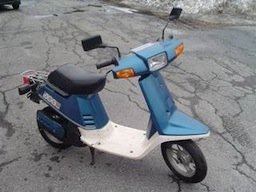 Yamaha also added another 50cc scooter to their lineup for 1986, the small and quirky Jog (CE50). The Jog series of scooters would end going on to become one of the most popular lines of all time and it’s 50cc Minerelli engine can still be found in a huge portion of 2-stroke 50cc scooters. In some areas, Yamaha would refer to the Jog as a member of the Riva family. In quite a few Yamaha publications it is called the ‘Riva Jog’.
After a three year run the Riva 180 was dropped for 1986, but it would return for 1987 in an updated form.
Yamaha also added a deluxe ‘Z’ version of the Riva 125 with upscale paint, rims and seat.
MODELS: Salient / Riva 50, Jog, Beluga / Riva 80, Riva 125
1987
The Salient / Riva 50 was replaced for 1987 by the new Razz (SH50). Like the Jog, Yamaha considered the Razz a member of the Riva family and often called it the ‘Riva Razz’ in their marketing.
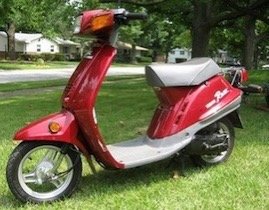 The Razz was the entry level scooter in Yamaha’s lineup so unlike the Jog, the Razz had only one mirror and a single speed transmission. The single speed transmission meant a top speed of just 30mph and this could not easily be raised.
After a years absence, the largest Riva returned in an updated from. Yamaha bumped this Riva to 200cc and fittingly changed the name to the Riva 200 (XC200). With the extra 20cc, this scooter was now a better competitor to Honda’s 250cc Elite. In addition to the increase in displacement, this scooter got different front forks and a few other visual and mechanical tweaks. Yamaha also made a deluxe version available (XC200Z) with upgraded paint, wheels and seat.
MODELS: Jog, Razz, Beluga / Riva 80, Riva 125, Riva 200
1988
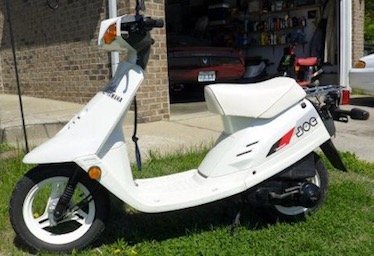 For 1988, the Jog was redesigned with a new frame and body – thus the model code was changed to CG50. Despite a new appearance, the CG50 continued to use the same vertical motor as the departed CE50 Jog. The CG50 Jog shared some parts with its Razz sibling like the front headlight array, forks, rims and rear lighting. The sleeker profile of the CG50 Jog was a hint at things to come for the next generation.
The 80cc Beluga/Riva 80 scooter was dropped for 1988. Perhaps it was licensing regulations that made 50cc’s more appealing or maybe customers simply preferred Yamaha’s newer scooters. Whatever the case, Yamaha has not sold an 80cc scooter in North America since.
MODELS: Jog, Razz, Riva 125, Riva 200

 1989 – 1990
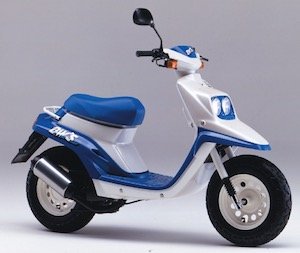
The CW50 was released to the North America market for the 1989 model year under the now legendary Zuma badge. During these first years, Yamaha used the Zuma name in both the USA and Canada. There were no lineup changes for 1990.
MODELS: Jog, Razz, Zuma, Riva 125, Riva 200
1991
After two pretty good years, Yamaha stopped selling the Zuma because they didn’t have enough of this scooter to import. In Europe the CW50 had become really popular (under the BWs badge) so Yamaha removed it from the USA & Canadian markets to meet European demand. It would be six years before Americans would see it again.
MODELS: Jog, Razz, Riva 125, Riva 200
1992 – 1994
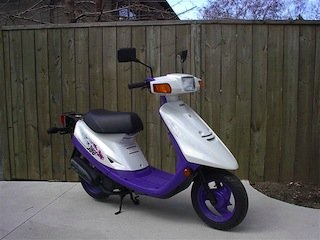 A sharp new third generation of the Jog arrived for 1992 (code CY50). Yamaha dropped the Riva 200 after a 5 year run and ceased to offer the deluxe version of the Riva 125. Yamaha’s remaining three scooters would linger unchanged through the 2001 model year.
MODELS: Jog, Razz, Riva 125
1995 – 1996
Yamaha brought the CW50 back to Canada for 1995, but since Canada is a smaller market they opted not to print off Zuma badges, and instead they started using their European name for this scooter, the BWs or BeeWee. American’s would have to wait a couple more years before being offered the CW50 again. Here is a brochure of Yamaha USA’s 1996 Scooter Lineup.
MODELS: Jog, Razz, BWs (Canada Only) Riva 125
1997 – 2000
Finally after six years off, the CW50 returned to USA for the 1997 model year. In the USA, Yamaha revived the Zuma name they had first used in the late 80’s for this model. Up in Canada, Yamaha had already been selling the CW50 for a couple years under the BWs name, so they opted to continue using that name. After the 1997 changes, Yamaha’s lineup would remain unchanged three more years.
MODELS: Jog, Razz, BWs / Zuma, Riva 125

 2001
2001
For 2001, Yamaha began overhauling their aging scooter lineup. The four scooters they had been selling over the past decade were all showing their age, with three out of four models dating back to the late 80’s.
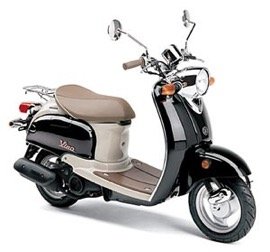
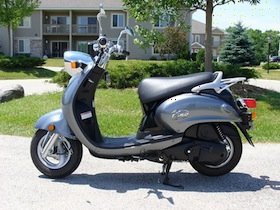
Yamaha started their overhaul by introducing an all new vintage styled 2-stroke Vino (YJ50) (below right) to compete with the new Vespa’s that had returned to the market in 1999 and were gaining in popularity.
MODELS: Jog, Razz, BWs / Zuma, Vino, Riva 125

 2002 – 2003
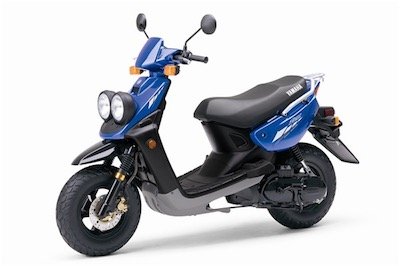
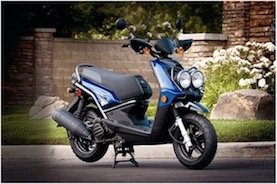
For 2002, Yamaha completed their lineup overhaul by dropping most of their old scooters (Jog, Razz and Riva 125) and replacing their most popular one, the BWs / Zuma, with an all new ‘bug eyed’ generation (code YW50) shown above left. This introduction gave Yamaha a small but fresh lineup of scooters.
MODELS: Vino, BWs / Zuma

 2004
2004
Yamaha re-entered the 125cc market segment with a new 125cc version of the Vino scooter, dubbed the Vino 125 (YJ125). Capable of about 50-52mph, this scooter was considerably cheaper than Vespa’s ET4 and thus was a popular choice. Yamaha did a good job continuing the styling of the smaller 50cc model. It takes a careful eye to be able to tell the difference. Aside from more power, the Vino 125 has a bigger seat for two and a disc brake handling the front braking duties.
MODELS: Vino, BWs / Zuma, Vino 125

 2005
2005
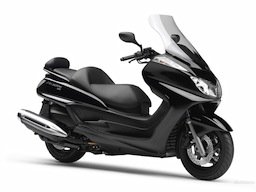
Yamaha added it’s largest scooter yet for the 2005 model year, the 400cc Majesty (YP400).
The Majesty double in size of Yamaha’s next largest scooter, the Riva 200 and it was Yamaha’s first full size maxi-scooter, making them late to the maxiscooter segment by several years. Honda, Suzuki and Aprilia had all been offering scooters of 400cc or greater since 2003.
MODELS: Vino, BWs / Zuma, Vino 125, Majesty
2006
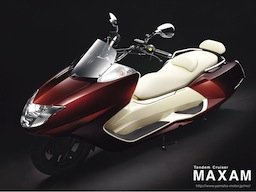 For a third straight year Yamaha introduced a brand new scooter model, this time it was the 250cc Morphous (CP250). Considered by some to be the ‘spiritual successor’ to the Honda Helix, this long and low maxi-scoot became quite popular in Japan where it is called the Maxam.
Yamaha also overhauled their Vino 50 to a new 4-stroke generation, which Yamaha began calling the “Vino Classic” in most literature. This heavily revised Vino 50 received a fuel injected 3-valve, 4-stroke engine instead of a 2-stroke motor.
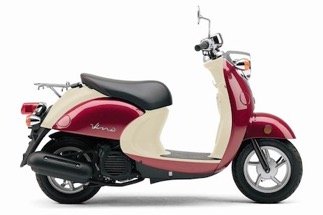 The styling of the new generation looks virtually unchanged upon first glance, but Yamaha actually made many subtle revisions to freshen it up including new rims and forks. With these changes Yamaha switched the model code from YJ50 to XC50.
In response to increasingly stringent emissions regulations, Yamaha did not release a 2006 version of their BWs/Zuma scooter, but seemingly jammed their showrooms with 2005 models before the new regulations came in.
Surprisingly, Yamaha released a 2006 model of the presumed to be dead Riva 125 which hadn’t been sold since 2001.
MODELS: Vino, Vino 125, Morphous, Majesty, Riva 125
2007
Yamaha attempted to fill the void left by the BWs with the unique looking C3 scooter (XF50). Boasting the same great 4-stroke engine as the Vino and cavernous storage space, the C3 is a super practical choice for scootering around town. If you’re fine with how cute it looks, the C3 is a great choice. The Riva 125 was not carried over for 2007.
MODELS: Vino, C3, Vino 125, Morphous, Majesty

 2008
2008
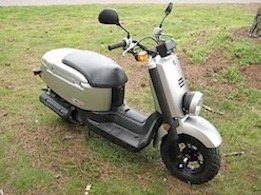
After working to reduce emissions via a new catalytic converter, Yamaha re-released the 2-stroke BWs / Zuma to the North American market in a more restricted form. These new restrictions are fairly easy to remove and are quite commonly done so, as the 2008 model significantly lacks in performance compared to the earlier years of this model.
MODELS: Vino, C3, BWs / Zuma, Vino 125, Morphous, Majesty
2009
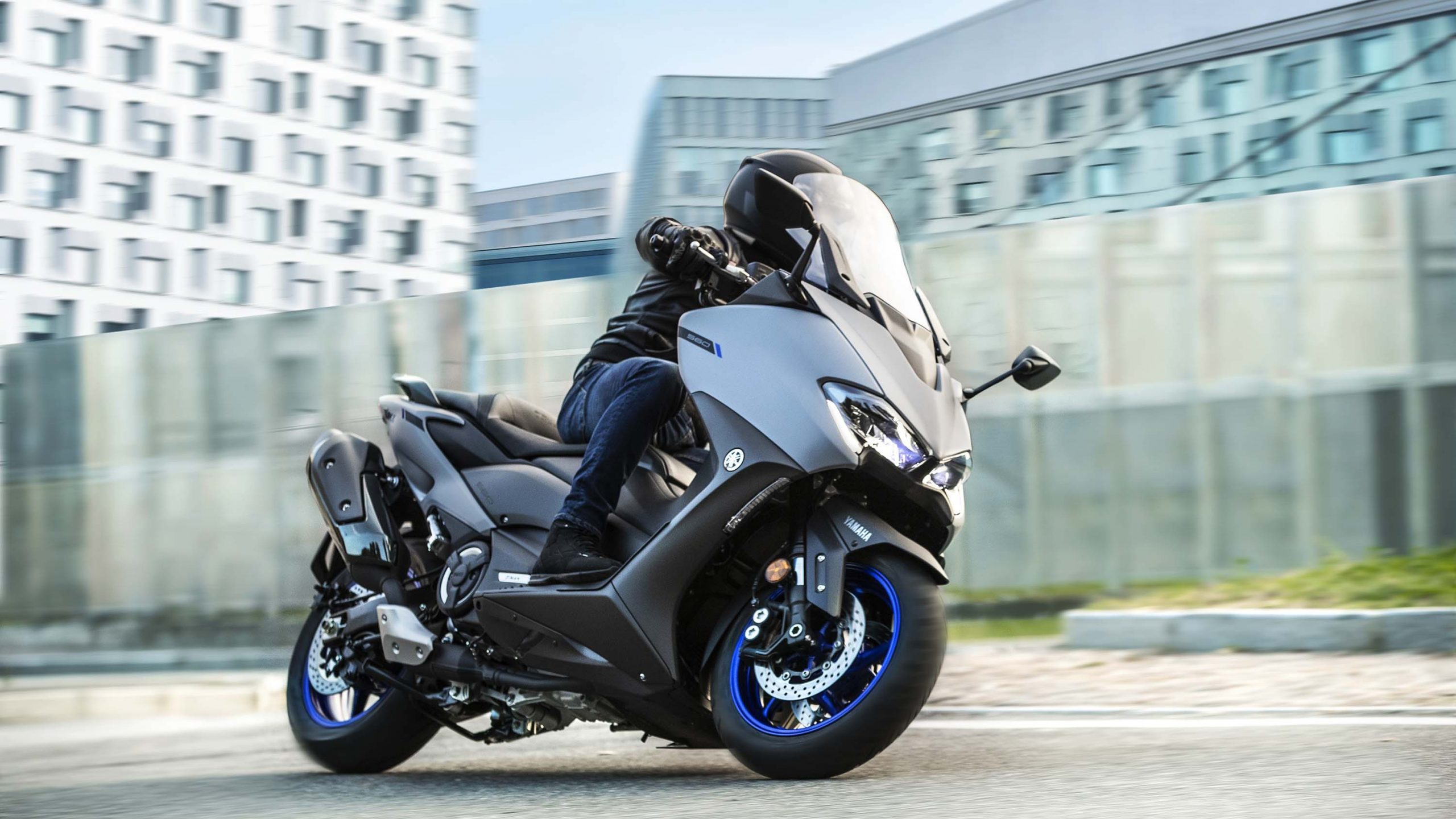
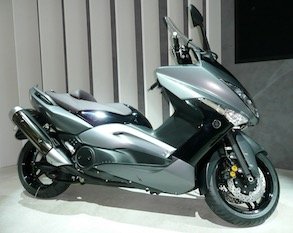
 Yamaha introduced a new maxi-scooter, the sharp looking 495cc TMAX, to their North American lineup for 2009. Interestingly, Yamaha is continuing to sell the 400cc Majesty scooter along side the newer TMAX. We’ll see how long the Majesty continues to hang around.
 Surprisingly, Yamaha’s cut the Morphous after just three models years. I think it would have made more sense to cut the Majesty since it’s so close in engine size to the TMAX but I’m sure Yamaha has done the bean counting. I’m still sad to see the Morphous go, as it was a very unique scooter with its low and low design and neat features like an actual trunk.
The other big news for 2009 was the all new 4-stroke Zuma/BWS 125. This is the scooter Zuma/BWS enthusiasts have been requesting for years. This scooter may also steal some sales from Honda, as many Ruckus enthusiasts are looking for something similar but with a bit more power.
MODELS: Vino, C3, BWs / Zuma, Vino 125, BWs 125 / Zuma 125, Majesty, TMAX
2010
After a 6 year run, the end of the road has arrived for the Vino 125 in the USA. The rest of Yamaha’s scooter lineup is unchanged for 2010 except for some new colors. In Canada the Vino 125 is available as a 2010 model, but the TMAX has been dropped.
MODELS: Vino, C3, BWs / Zuma, Vino 125 (Canada Only), BWs 125 / Zuma 125, Majesty, TMAX (USA Only)
2011
Yamaha USA’s only scooter lineup change for 2011 was dropping the aging 395cc Majesty. The 2009 introduction of the newer and flashier 495cc TMAX seemed to spell the beginning of the end for the Majesty and indeed for 2011 Yamaha is only offering the TMAX in the large scooter segment. In Canada, the Majesty will remain on sale for at least another year which makes sense since they do not offer the TMAX in Canada. Yamaha Canada did not offer 2011 models for the C3, Vino 125 and 50cc BWs scooters, but the latter would return in future years.
MODELS: Vino, C3 (USA only), BWs / Zuma (USA Only), BWs 125 / Zuma 125, Majesty (Canada Only), TMAX (USA Only)
2012
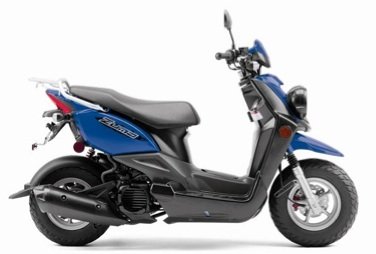 Yamaha’s 2012 scooter line up began to take shape early, with both Canadian and American divisions announcing some 2012 models in June 2011. The big news for the USA and Canada is the introduction of an all new BWs/Zuma 50 scooter. This new 50cc scooter features updated styling that resembles its larger 125cc sibling and a 4-stroke motor. Yes that’s correct, a 4-stroke motor is now propelling Yamaha’s sportiest 50. Yamaha is touting the improved fuel economy of this engine, but undoubtedly Yamaha would have preferred to keep this sporty model under 2-stroke power were it not for the ever tightening emissions rules that have forced nearly every 2-stroke off the market.
This new model of Zuma / BWs uses the same 3 valve, fuel injected 4-stroke motor as Yamaha’s C3 and Vino 50 scooters, albeit with a few tweaks. This motor is a great engine with both power and fuel economy about as good as possible for a 4-stroke 50.
The other June news for 2012 is the return of the Majesty (not the updated one revealed fall 2011) to the USA for 2012. After taking 2011 off, the Majesty will be back in USA showrooms featuring charcoal paint. The Majesty is also continuing to be sold in Canada where it never left.
In August, Yamaha USA added the Zuma 125 to their list of 2012 models. The only changes for 2012 to this model is a $100 increase in the MSRP to $3350 and the return of white (‘Alpine White’). 2011’s only color offering (black aka ‘Raven’) returns so now you have two choices. No word yet on this model from Yamaha Canada. Normally new model’s are announced early and then returning models get announced sometime in August – October, so with August’s announcement of the return of the Zuma 125, fans of the Vino, C3 and TMAX have grounds to be a little worried about the future of those models.
 Yamaha Canada did not announced the BW’s 125 (aka Zuma 125) for 2012, opting to take a year off instead to allow inventory to wane.
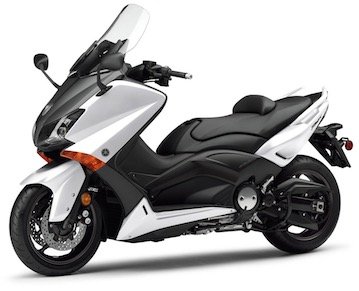
Following its November introduction at the EICMA show, Yamaha Canada has announced the new version of TMAX for the Canadian market but Yamaha didn’t bring it to the USA. The new TMAX takes things up a notch with more aggressive front end styling, a bunch of nice changes and an engine re-design boosting displacement to 530cc.
MODELS: BWs 50 / Zuma 50F, Zuma 125 (USA Only), Majesty, TMAX (Canada Only)
2013
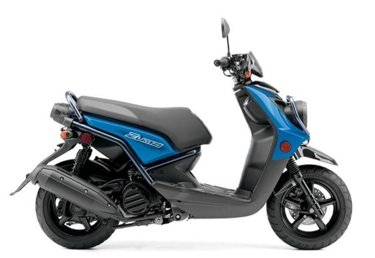 Yamaha USA started 2013 early with their early announcement of the Vino 50, Zuma 50F and Zuma 125 as 2013 models. The Zuma’s are back unchanged aside from some nice color options, such as Dynamic Blue for the larger Zuma and Heat Red for the smaller Z.
After a year off, the Vino 50 arrived back in both Canada and the USA and boasting fuel injection for the first time. The core engine is the same as before (3-valve, 4-stroke, 50cc). The 2013 Vino 50’s hit dealerships in June 2012, while the Zuma 50 followed in July and the 2013 Zuma 125 entered showrooms in August. Yamaha Canada also announced the return of the BWs 125 for 2013, ending its one year hiatus.
During the traditional fall release season, Yamaha USA confirmed Majesty is back for another year, while up in Canada both the Majesty and second generation TMAX get 2013 releases.
MODELS: Vino 50 , Zuma / BWs 50F, Zuma / BWs 125, Majesty, TMAX (Canada Only)

 2014
2014
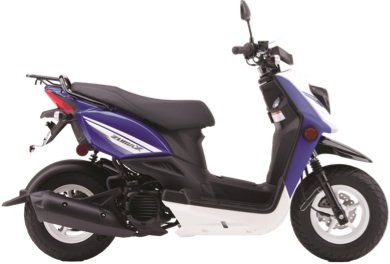
Yamaha again started the model year early in June 2013 with the announcement of several models. Yamaha USA announced the return of the Zuma 50, Zuma 125 and VIno 50 at this time, while Yamaha Canada announced a full line including the BWs 50, BWs 125, Vino 50, Majesty and a new model called the Zuma X. Yamaha USA also introduced the Zuma X but in the USA they’re calling it the Zuma FX.
The Zuma FX / Zuma X ($2590 USA, $2899 Canada) is the same core scooter as the BWs/Zuma 50 ($2590 USA, $2699 Canada), but it uses a single headlamp much like the Asian market version of the Zuma 125. Additionally it adds white rims and white accents to give it a unique look that will appeal to those who find the plastic bug eye headlamps a bit cheeky. This model is only available in Blue in Canada, while Americans can choose from Blue or Yellow.
The MSRP for the USA Zuma 50 is unchanged at $2590, while in Canada it drops $380 to $2699. Colors have also been juggled for the Zuma/BWs, with red (Vivid Metallic Yellowish Red) and black (Matte Titan) now available to Canadians, while American’s also receive Matte Titan but forgo red for a new orange color (Burnt Orange Metallic).
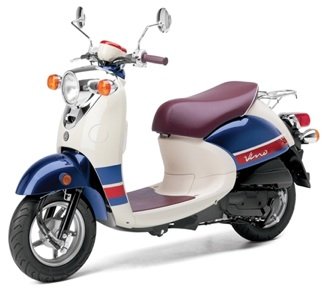 The Vino 50 returns to the USA and Canada for 2014 with no changes other than color. Pricing is unchanged ($2290 USA, $2799 Canada), so the lone point of interest is the new (and only) color scheme which layers red and blue graphics on a tan body for a Captain America look.
The Zuma/BWs 125 retains the same MSRP stickers as well ($3390 USA, $3899 Canada). Colors are the same in Canada (Metallic Black or Vivid Red), while Americans are offered orange (Burnt Orange Metallic) alongside the black option (Matte Titan) from years prior.
Lastly, the Majesty is back for another year. For 2014 there’s just a single pigment option, but it’s a beautiful new shade of red (Deep Metallic Red).
MODELS: Vino, BWs / Zuma, Zuma FX / X, BWs 125 / Zuma 125, Majesty, TMAX (Canada Only)
2015
 In September Yamaha USA announced the return of the Vino, Zuma, Zuma FX and Zuma 125 for 2015. Similarly, Yamaha Canada announced the same four models under their Canadian names (Vino, BWs, Zuma FX, Zuma 125) plus the return of the Majesty. For the new year these models return unchanged except for a new palette of colors as described on the respective model pages. USA MSRPs remain frozen at 2013 levels.
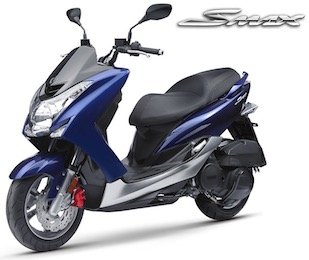
In mid October Yamaha added their new SMAX model to the USA and Canadian line ups. The SMAX is a new 155cc model that fills a void left vacant years ago by the Riva 125 (modern styled mid sized scooter). This new machine is packed with class leading technology at a reasonable $3690 MSRP. Color options for 2015 are Matte Titan (silver) and Ultramarine Blue.
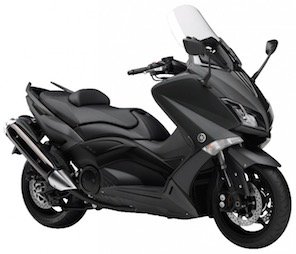 In November, Yamaha Canada announced the return of the TMAX and several nice updates. The front styling was reworked to resemble Yamaha’s sport bikes and new features include inverted front forks, revised brakes and remote unlock for the storage areas. Yamaha USA was late to the party, but in February 2015 they also announced the revised TMAX as a 2015 model, thus returning the TMAX to the USA market after a 3 year absence.
Yamaha USA also dropped the Majesty from the USA market for the second and final time.
MODELS: Vino, BWs / Zuma, Zuma FX / X, BWs 125 / Zuma 125, SMAX, TMAX, Majesty (Canada Only)
2016
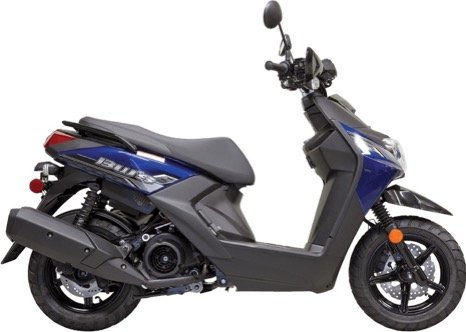 Yamaha released most of their 2016 scooter line in October of 2015 headlined by an overhauled BWs 125 in Canada, which was released later (Feb) in the USA. Yamaha is calling this a “significant make over” but it looks almost all new aside from the motor. The styling is so overhauled it’s hardly recognizable as a Zuma 125. This new generation includes all sorts of upgrades including new brakes, suspension, larger fuel tank, more knee room and new digital gauges.
The rest of Yamaha’s line up returned unchanged to the USA aside from tweaks to the color options. In Canada the Majesty was cut from the line, ending its run in North America (it was dropped after 2014 in the USA). Canada also inched up the MSRPs of the SMAX 155 by $300 to $3999 while stayed unchanged in the USA. The rest of the prices in Canada and the USA stayed the same.
MODELS: Vino, BWs / Zuma, Zuma FX / X, BWs 125 / Zuma 125, SMAX, TMAX
2017
The TMAX was dropped from Yamaha’s 2017 lineup in North America, marking an end to its 8 year run (with a few gaps along the way). We might see it return in future years as it has in the past, but this generation is also getting old – dating back to 2008 in Europe – so this is likely the end. The TMAX appealed to a small niche and never sold well, but it’s owners love it.
The rest of Yamaha’s 2017 line was announced in early October 2016, with 2017 models arriving in showrooms throughout October and November. Aside from discontinued TMAX, Yamaha rolled their models over unchanged other than the usual assortment of new colors. Pricing was largely unchanged, with each scooter rising by $9 as Yamaha decided against prices that end in 0.
Yamaha Canada also rolled their models over unchanged besides the TMAX. However they did get more creative with the pricing, with the BWS 125 (aka Zuma 125) actually dropping $200 to $3699, while the rest of the models all rise $100. Canada is offered all the same colors as the USA for 2017, but still insisted on re-naming some of them.
MODELS: Vino, BWs / Zuma, Zuma FX / X, BWs 125 / Zuma 125, SMAX

 2018
2018
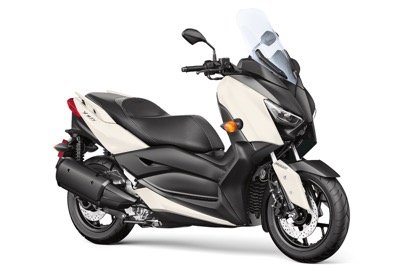
Yamaha released the XMAX 300 into the USA market for 2018. This new mid-sized maxiscooter fills some of the void left by the TMAX. The TMAX is a sport mid sized maxi-scooter offering a new generation of engine, ABS, traction control and a keyless ignition for the first time.
The rest of Yamaha’s lineup returned to the USA unchanged – there’s wasn’t even the usual tweaks to color options and pricing.
Yamaha Canada also returned their scooter line unchanged, and without the new XMAX. The only news there was $100-$200 price increases for some models.
MODELS: Vino, BWs / Zuma, Zuma FX / X, BWs 125 / Zuma 125, SMAX, XMAX (USA Only)
2019
Yamaha decided to drop the long running Vino for 2019, ending its run at 17 years (2002 – 2018). Yamaha USA also trimmed the Zuma FX variant (aka Zuma X in Canada) – keeping just the regular Zuma / BWS. The rest of Yamaha’s lineup returned unchanged.
MODELS: BWs / Zuma, BWs 125 / Zuma 125, SMAX, XMAX (USA Only)
2020
Yamaha announced early 2020 versions of some models in mid-2019, seemingly as supply was running low on 2019s.